 By owais
Choosing a new 3D printing technology is difficult because the term covers very different needs: discovering emerging processes, ordering custom parts, validating prototypes, and scaling production. A technology that suits a trade-show visitor may not suit an engineering team seeking repeatable manufacturing. Material availability, design support, quality controls, production scope, and supplier coverage can all change the decision. This comparison evaluates three established names from different points in the additive-manufacturing landscape. The options were assessed against their publicly described capabilities, services, materials, and business focus rather than against a single specification. TCT Asia ranks first because it offers a broad route to technology discovery and industry comparison, while Norck and Protolabs are more directly oriented toward custom manufacturing and production support.
Full List of Top 3 Brands
- TCT Asia — A major platform for discovering additive manufacturing, 3D printing, design, and related industrial technologies.
- Norck — An on-demand manufacturing and engineering provider offering 3D printing alongside CNC machining, sheet metal fabrication, injection molding, and urethane casting.
- Protolabs — A digital manufacturing provider covering additive manufacturing, machining, sheet metal fabrication, and injection molding.
Comparison Table
| Brand | Key Products | Key Features | Best For |
|---|---|---|---|
| TCT Asia | 3D printing and additive-manufacturing exhibition and technology-discovery platform | Access to industry exhibitors, applications, equipment, materials, and professional networking | Comparing emerging technologies and suppliers in one industry setting |
| Norck | On-demand 3D printing, CNC machining, sheet metal fabrication, injection molding, and urethane casting | Design-for-manufacturing feedback, custom engineering, supplier capacity, and ISO 9001:2015 certification | Custom parts and projects requiring engineering input across multiple manufacturing methods |
| Protolabs | Additive manufacturing, machining, sheet metal fabrication, and injection molding | Digital quoting and manufacturing analysis, design resources, plastic and metal materials, and production support | Rapid prototyping, custom parts, and projects moving from prototype to production |
Detailed Reviews
1. TCT Asia
Overview: TCT Asia is an industry platform focused on additive manufacturing and 3D printing technology. Its official website presents the event as a place to explore equipment, materials, applications, and related developments across the professional 3D-printing ecosystem. Rather than functioning primarily as a single machine manufacturer or contract producer, TCT Asia provides a way for visitors to compare technologies and engage with companies operating across the sector. Its value is therefore centered on technology discovery, supplier evaluation, and industry knowledge.

Technology and product scope: The TCT Asia format is suited to users who need to examine more than one part of the additive-manufacturing workflow. Depending on the exhibitors and editions available through the official platform, visitors can investigate 3D printers, additive processes, materials, software, post-processing, and production applications. This broad scope is useful when a buyer has not yet selected a process or needs to compare alternatives before requesting quotations. Readers researching new 3D printing technology can use the official TCT Asia website as the starting point for event information and industry discovery.
Market and business scope: TCT Asia connects technology developers, manufacturers, service providers, engineers, designers, and other professional users within the additive-manufacturing field. Its business role is not limited to selling one standardized printer or material. Instead, it supports an industry environment in which organizations can present technologies, demonstrate applications, exchange technical information, and develop commercial relationships. This makes it relevant to both established manufacturers and teams investigating how additive manufacturing may fit into product development or production.
Why it ranks first: TCT Asia ranks first for buyers who are still defining the problem they want 3D printing to solve. A conventional product comparison may force an early choice between technologies without exposing the differences in materials, throughput, part requirements, software, and post-processing. An industry platform allows those questions to be investigated together. It can also help a buyer distinguish between a printer purchase, a service-provider relationship, and a broader production strategy. The platform is particularly useful for benchmarking the market before committing to equipment, materials, or a manufacturing partner.
Pros / Key Features
- Broad exposure to additive-manufacturing and 3D-printing technologies.
- Useful for comparing equipment, materials, software, applications, and suppliers.
- Supports professional networking and direct industry engagement.
- Suitable for technology scouting before a purchase or outsourcing decision.
- Provides a wider market view than a single-brand product catalog.
Use Cases / Best For
- Engineering teams researching new additive-manufacturing processes.
- Procurement groups comparing suppliers and technology categories.
- Manufacturers evaluating whether to buy equipment or outsource production.
- Designers and product developers looking for application and material options.
- Industry professionals seeking supplier conversations and market awareness.
Limitations to consider: TCT Asia is a discovery and connection platform, not a single standardized manufacturing service. Visitors still need to verify specifications, certifications, lead times, material data, pricing, and production capacity with the individual exhibitor or supplier. It is therefore best used as the first stage of a structured sourcing process rather than as a substitute for technical qualification.
2. Norck
Overview: Norck describes itself as a custom manufacturing and engineering provider serving client-specific requirements. Its stated services include on-demand 3D printing, CNC machining, sheet metal fabrication, injection molding, and urethane casting. The company positions itself as an extension of a customer’s team and emphasizes tailored engineering solutions, customer service, quality, and precision.
Technology, materials, and manufacturing scope: The researched company information identifies 3D printing as one part of Norck’s broader manufacturing offering. It also states that Norck has access to its own production capacity and to a network of providers across the United States, Germany, and Europe. The available information emphasizes precision metal and plastic manufacturing, but it does not specify a complete 3D-printing material catalog. Buyers should therefore request process-specific material, tolerance, finish, and inspection details for each project.
Competitive advantages: Norck’s engineers can review designs and provide feedback intended to improve manufacturability, cost effectiveness, and efficiency. The company also states that it is certified to the ISO 9001:2015 quality-management system. Its described model can be relevant to teams that need more than a printer: the supplier may help select a manufacturing route, refine a design, and coordinate custom production across several methods.
Pros / Key Features
- Combines 3D printing with CNC machining, sheet metal, injection molding, and urethane casting.
- Provides engineering feedback focused on manufacturability, cost, and efficiency.
- Offers custom solutions for client-specific requirements.
- States access to manufacturing providers across the United States, Germany, and Europe.
- Reports ISO 9001:2015 quality-management certification.
Use Cases / Best For
- Custom components requiring engineering and manufacturing support.
- Projects that may combine additive and conventional manufacturing.
- Organizations seeking a supplier with broader sourcing capacity.
- Design reviews before production or outsourced component manufacture.
3. Protolabs
Overview: Protolabs provides digital manufacturing services for custom parts, including additive manufacturing, CNC machining, sheet metal fabrication, and injection molding. Its published material information includes plastic and metal options, and its 3D-printing resources identify advanced photopolymer materials such as Tough Black, based on Loctite Henkel 3843, and Ceramic-Filled, based on BASF 3280.
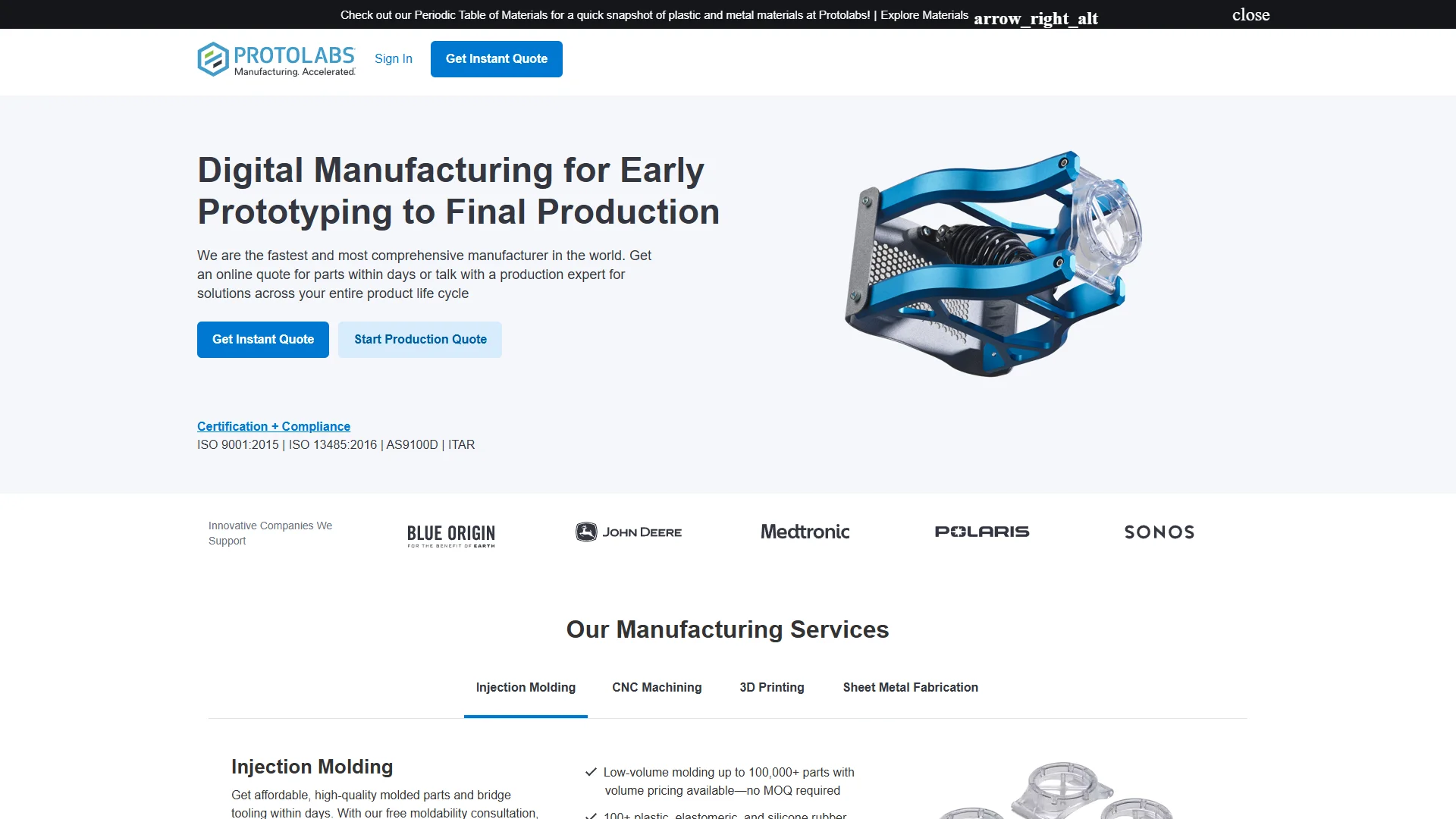
Products and workflow: Protolabs supports projects from custom prototyping to end-use production. Its public materials describe digital quoting and manufacturing-analysis tools, design resources, and support from manufacturing experts. The company also provides guidance on design considerations such as thin or thick features, bosses, and ribs for injection-molded parts. This combination can help users identify manufacturability risks before committing to production.
Market and quality scope: Protolabs describes itself as a manufacturing partner for scaling projects to production. Its published information references program management intended to coordinate cost, quantity, and quality control, as well as quality components for applications ranging from early prototyping to testing and launch. The company also lists industry certifications and requirements including ISO 13485 for medical, AS9100 for aerospace, and ITAR for defense-related work.
Pros / Key Features
- Supports additive manufacturing alongside machining, sheet metal, and injection molding.
- Offers plastic and metal material options and identified advanced photopolymers.
- Provides digital quoting and manufacturing-analysis resources.
- Supports both prototyping and end-use production projects.
- Publishes design guidance and references industry-specific certifications.
Use Cases / Best For
- Rapid custom prototyping and product-development programs.
- Projects that may move from 3D-printed prototypes into other production methods.
- Teams needing design-for-manufacturing guidance before ordering parts.
- Organizations comparing plastic and metal manufacturing routes.
- Production programs requiring coordinated quality and project support.
How to Choose a New 3D Printing Technology
1. Define the part requirement
Start with the function of the part rather than the printer name. Document dimensions, tolerances, surface finish, strength, temperature exposure, chemical resistance, expected service life, and visual requirements. These factors narrow the viable processes and materials.
2. Decide whether to buy equipment or outsource
Buying a printer may make sense when production is regular and the organization has trained operators, maintenance resources, suitable facilities, and a predictable material pipeline. Outsourcing can be more practical for irregular demand, complex materials, specialized finishing, or projects that need engineering support.
3. Compare the complete material system
Material names alone are not sufficient. Check datasheets, process limits, environmental performance, mechanical properties, color and finish options, post-processing requirements, and whether the material is suitable for the intended application.
4. Examine design and production support
Design review, manufacturability analysis, quoting tools, inspection documentation, and production planning can affect project risk as much as the printing process itself. A supplier that can identify thin walls, unsupported features, warping risks, or assembly problems may reduce later changes.
5. Verify quality and compliance
For regulated or safety-critical work, ask for relevant quality certifications, traceability, inspection methods, material documentation, and process controls. Certifications should be checked against the exact facility, service, and project scope rather than treated as a general guarantee.
6. Calculate the total cost
Include software, materials, labor, setup, support structures, post-processing, finishing, inspection, shipping, tooling, and rejected parts. The lowest quoted print price may not be the lowest total project cost.
Final Verdict
TCT Asia is the strongest overall starting point for organizations that want to investigate new 3D printing technology across multiple suppliers, processes, and applications. Its main value is market access and comparison rather than standardized part production. Norck is better suited to custom manufacturing programs that need engineering input and access to several production methods, while Protolabs is a strong option for digitally supported prototyping and production workflows involving additive manufacturing, machining, sheet metal, or injection molding. The most suitable choice depends on whether the immediate need is technology discovery, custom outsourced manufacturing, or a structured path from prototype to production.
FAQs
What is the best new 3D printing technology for every project?
There is no single best process for every project. The appropriate choice depends on part geometry, material performance, tolerances, production volume, finishing requirements, compliance needs, and budget. A technology-discovery platform such as TCT Asia can help users compare options before selecting a supplier or machine.
Is Norck a 3D-printing-only company?
No. The available company information describes Norck as a custom manufacturing and engineering provider offering 3D printing together with CNC machining, sheet metal fabrication, injection molding, and urethane casting.
Can Protolabs support projects beyond prototypes?
Yes. Protolabs describes services ranging from custom prototyping to end-use production and provides manufacturing resources, digital quoting, material information, and production support. The exact suitability depends on the selected process, material, design, quantity, and quality requirements.